Social Media for Care Homes- A practical Guide to Getting It Right
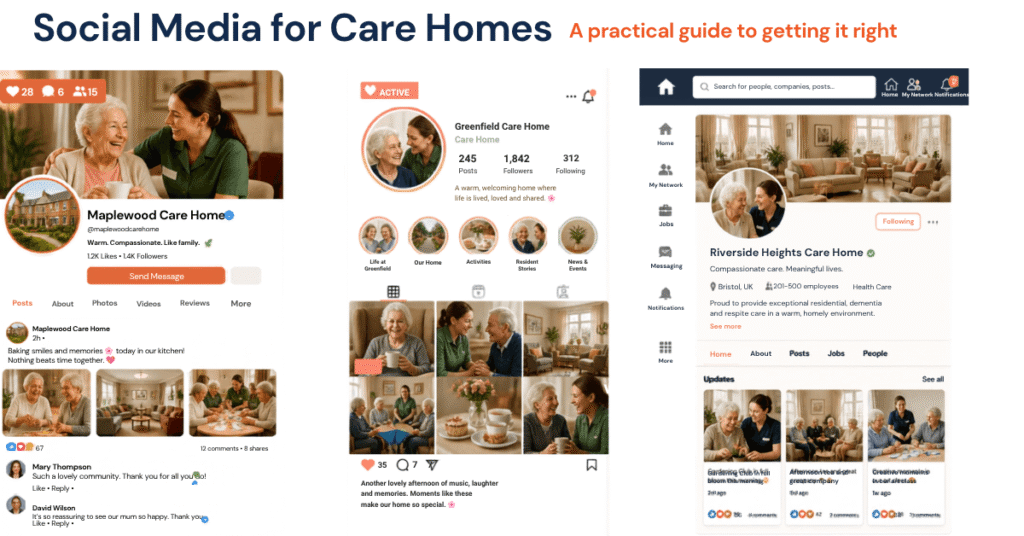
Table of Contents
Introduction
Social media for care homes has quietly become the first checkpoint families visit before they ever pick up the phone. They’ll scroll through your social media page – Facebook, Instagram — to check your last few posts, look at your photos, notice how — or whether — you respond to comments, and form a judgement in seconds: does this home feel warm, active, and well-run, or does it feel forgotten?
Most care homes know they “should” be on social media, but few have a clear plan for what to post, how often, or which platforms actually matter. The result is usually one of two things: no presence at all, or a page that hasn’t been touched in eight months.
This post walks through a practical approach to social media for care homes — the platforms worth your time, what to post, how often, and how to keep it sustainable without needing a full marketing team.
Benefits of social media for care homes
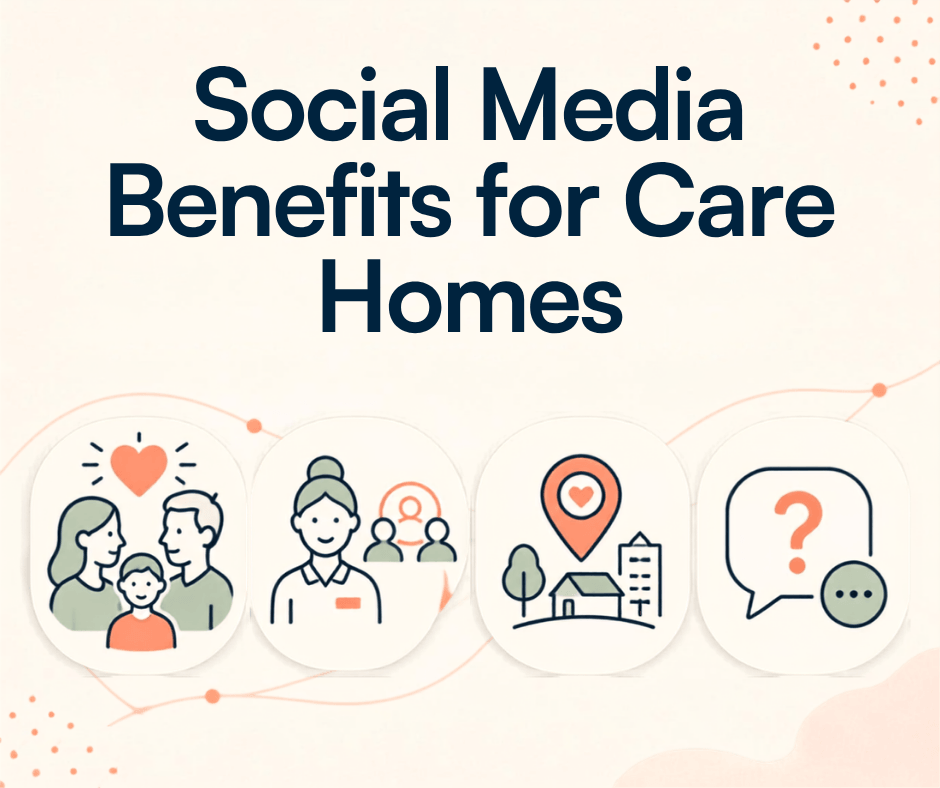
Social media for care homes isn’t about going viral — it’s about building awareness of the great work you’re doing, and building quiet, ongoing trust with three audiences at once: families researching care, potential staff, and the local community.
Here are the core benefits, grouped by audience:
Helps to win families researching care
- Builds trust before the first phone call — an active page reassures families the home is well-run and attentive
- Shows day-to-day life (activities, meals, staff interactions) that a website alone can’t capture
- Provides social proof through comments, shares, and visible community engagement
- Humanises the decision — families are choosing people and culture, not just a facility
Staff recruitment
- Showcases team culture and working environment to attract quality candidates
- Reduces reliance on paid job ads by building an organic talent pipeline
- Gives potential hires a genuine feel for the home before applying
Local reputation and referrals
- Builds visibility with GPs, social workers, community groups, and discharge coordinators who refer families
- Strengthens ties with local community groups, schools, and charities through visible involvement
- Reinforces credibility alongside Google reviews and search presence
Occupancy and enquiries
- Keeps the home visible to families who aren’t ready to enquire yet, but will be later
- Shortens the trust-building process, often leading to faster decisions once a family does enquire
- Differentiates the home from competitors with inactive or outdated online presence
To answer queries
- Gives families a quick, low-pressure way to ask questions (availability, visiting hours, fees) without committing to a phone call
- Comments and DMs let you respond publicly, which reassures other families watching who haven’t asked yet
- Reduces pressure on your front-of-house or admin team by deflecting simple, repeat questions to a visible FAQ post or pinned content
- Allows real-time updates during time-sensitive situations (e.g. visiting restrictions, availability changes) that families check before calling
- Builds a searchable record of common questions and answers that new visitors to the page can scroll through themselves
Main social media platforms to choose from
There’s a wide range of social media channels to choose from, with Facebook, Instagram, and LinkedIn standing out as popular and effective options for care providers.
You don’t need to be everywhere. Most care homes get the best return from focusing on two platforms well rather than five platforms badly.
Still the primary platform for the age group most likely to be researching care for a parent — typically adults aged 45–65. Facebook’s events and reviews features double up as extra trust signals alongside your Google profile.
Strong for photos and short videos of activities, staff, and day-to-day life, and increasingly used for recruitment. Reels in particular reach non-followers through Instagram’s discovery feed, making it one of the more effective platforms for getting in front of families who haven’t found you yet. Stories are useful for lighter, in-the-moment updates that don’t need to be polished.
Valuable for staff recruitment, partnerships, and building the home’s professional reputation. It has a business focus so it’s the perfect place for more business-oriented updates about your organisation. LinkedIn carries more weight for credibility and B2B relationships than for direct family enquiries.
Other options
TikTok
Optional, but effective for recruitment-focused content aimed at younger care staff. Short, authentic behind-the-scenes clips tend to outperform polished content here, and it’s increasingly where care assistants and support workers discover employers before checking a job board.
Twitter (X)
Optional, but a great place for sharing short and snappy updates and commenting on current topics of interest. It’s less about family-facing content and more useful for engaging with local news, sector bodies (CQC, Skills for Care, ADASS), and journalists — helpful for building visibility and authority within the wider care sector conversation.
YouTube
YouTube works well as a home for longer-form content — live videos, virtual tours, family testimonials, staff interviews, or “a day in the life” videos — that can then be embedded on your website and shared across other platforms rather than standing alone as its own channel.
What to actually post
The biggest reason a care home social media profile goes quiet isn’t lack of time or budget — it’s running out of ideas. Teams post enthusiastically for the first few weeks, then hit a wall wondering what’s left to share, and the page slowly goes silent.
In reality, the content problem is rarely a content shortage — it’s a capturing problem. Most care homes have far more happening each week than they realise: an activity session, a birthday, a visiting relative, a new starter settling in, a garden coming into bloom. None of it feels “newsworthy” in the moment, which is exactly why it goes unposted. But this ordinary, everyday material is precisely what families want to see — it’s proof of life, not a highlight reel. The fix isn’t generating new ideas from scratch; it’s building a habit of noticing and capturing what’s already happening, as it happens.
Activities and events (arts and crafts, music sessions, birthdays, seasonal celebrations)
These are the easiest wins because they already happen on a schedule — you’re just documenting, not creating extra work. A quick photo or short clip from a music session or a resident’s birthday shows life and energy in the home, and seasonal content (Christmas decorations, summer fetes, Remembrance Day) gives you a natural, recurring content calendar without needing to think up new ideas each month.
Staff spotlights — a short intro to a team member and their role
Families want to know who’s actually caring for their relative, not just see a building. A short post introducing a carer, activities coordinator, or chef — their name, their role, maybe why they love the job — builds a sense of familiarity before a family ever visits. These also double as recruitment content, showing prospective staff what the team culture looks like from the inside.
Resident-approved moments (always with proper consent) that show warmth and personality
This is often the most powerful content type, since it shows real relationships and daily joy rather than a marketing message. A resident laughing during an activity, a friendship between two residents, a small personal milestone — these humanise the home in a way no amount of polished copy can. Consent must be explicit, documented, and revisited regularly (family members should be comfortable too), but done properly, this content builds trust faster than almost anything else you post.
Behind-the-scenes glimpses — meal prep, garden updates, a typical morning
Families researching care are often anxious about the unknowns — what does a normal day actually look like? Behind-the-scenes content answers that quietly, without needing to say it directly. A short video of breakfast being prepared, the garden in bloom, or the morning handover between shifts reassures families that the home runs smoothly even when no one’s watching.
Family-facing information — visiting hours, funding guidance, admissions process
Not every post needs to be warm and lifestyle-focused — some of the most useful content simply answers practical questions families are already searching for. A clear post on visiting hours, how funding assessments work, or what the admissions process involves reduces friction for families who are ready to take the next step, and it’s content you can reuse and repost periodically.
Community involvement — local partnerships, fundraising, school visits
This shows the home isn’t isolated — it’s an active, connected part of the local area. A fundraising event, a visit from a local school choir, or a partnership with a nearby charity signals a home that’s outward-facing and well-regarded, which matters both to families and to referral partners like GPs and social workers who want to recommend a home with a good local reputation.
How often you should post
Consistency matters far more than volume. A care home posting twice a week, every week, will build more trust than one posting daily for a month and then going silent for three — because families and algorithms both read patterns, not bursts. An inconsistent page, even one with occasional great content, sends a subtle signal that the enthusiasm didn’t last, which is the opposite impression you want to give someone deciding where to place a parent.
Platform algorithms also reward reliability. Facebook and Instagram tend to deprioritise pages with long gaps between posts, meaning a burst of activity after months of silence often reaches far fewer people than a steady, modest rhythm would have. A realistic, sustainable pace — even if it’s just two posts a week — will outperform an ambitious schedule that inevitably slips, because it’s the one you’ll actually stick to.
Facebook & Instagram: 2–3 posts per week is a sustainable, effective baseline
This frequency is enough to keep the page visibly active and stay in families’ feeds without becoming a burden on whoever manages it. It’s frequent enough for the algorithm to keep showing your content to followers, but light enough that it can realistically be maintained by one person alongside their other responsibilities — which matters more than any theoretical “ideal” posting frequency, since a schedule that gets abandoned after a month does more harm than a modest one kept up for a year.
LinkedIn: 1–2 posts per week focused on culture, recruitment, and sector involvement
LinkedIn’s audience is different from Facebook and Instagram — it’s largely staff, prospective hires, referral partners, and sector professionals rather than families — so the content and frequency should reflect that. A lighter, more focused posting rhythm here (team culture, open roles, involvement in sector events or CQC-related news) builds professional credibility without needing daily upkeep.
Respond to comments and messages within 24 hours — families notice responsiveness as much as content
A beautifully curated page loses its value if a question in the comments sits unanswered for a week. Families often test responsiveness deliberately — asking a simple question via Messenger or a comment — as a proxy for how attentive the home will be once a relative is living there. A prompt, warm response (even just “Thanks for asking — give us a call on [number] and we’ll help”) does more for trust than another post would.
Use a simple social media content calendar and scheduling tool so posting doesn’t rely on someone remembering on the day
Most care home social media accounts go quiet not from lack of content but from lack of a system — posting becomes something squeezed in “if there’s time,” which means it’s the first thing dropped during a busy week. A simple calendar (even a shared spreadsheet listing what’s being posted and when) or Meta business suite turns social media from an ad hoc task into a routine, and makes it easy to plan around known events — birthdays, seasonal dates, staff anniversaries — well in advance.
Turning social media into enquires
Social media rarely closes an enquiry on its own — nobody books a care home purely because of a Facebook post. But it consistently influences the decision happening in the background, shaping how a family feels about a home long before they pick up the phone. By the time someone calls or fills out an enquiry form, they’ve usually already formed an opinion from scrolling your page, checking your last few posts, and gauging whether the home feels active and genuinely cared for. This is one of the benefits of using social media for care homes.
This is why social media works best as part of a wider trust-building system rather than a standalone lead-generation channel. It rarely gets credit as “the reason” a family enquired, because its impact happens earlier and more subtly — softening scepticism, answering unspoken questions, and making every other touchpoint (your website, your Google reviews, that first phone call) land better because the family already feels reassured. A well-run page doesn’t generate enquiries on its own; it removes the doubts that would otherwise stop one from happening.
Action points
- Add a clear call-to-action in your bio (phone number, “Book a visit” link)
- Pin a welcoming introduction post to the top of your page for new visitors
- Cross-post strong content to your Google Business Profile for extra visibility
- Encourage families to leave reviews after a positive visit, and share (with permission) positive feedback
For further inspiration, Skills for Care has put together a helpful piece on how social care organisations are using social media effectively, complete with real examples from providers across the sector. You can read Putting the Social Media in Social Care for more tips and case studies.
Prefer expert hands-on support?
Book a free social media audit with Wallwide Media and we’ll show you exactly what’s working, what’s missing and where to focus first.
Frequently asked questions.
Do care homes really need to be on social media?
Care homes don’t strictly need social media the way they need a Google Business Profile, but an active social media presence plays a growing role in how families evaluate a care home before enquiring. A care home with an active page reassures families it is well-run, staffed, and engaged with residents’ daily lives, while an inactive or missing page can raise doubts even when the standard of care is excellent.
Which social media platform is best for care homes?
Facebook and Instagram are the best starting platforms for care homes, since they reach the 45–65 age group most likely to be researching care for a parent and support photo and video content well. LinkedIn becomes valuable for care homes once staff recruitment and professional reputation become a priority, while TikTok and Twitter (X) remain optional, niche additions for most care homes.
How often should a care home post on social media?
A care home should post 2–3 times per week on Facebook and Instagram as a sustainable, effective baseline. Consistency matters more than volume for care home social media — a care home posting steadily twice a week builds more trust over time than one posting daily for a month and then going silent for three.
What should a care home avoid posting on social media?
A care home should avoid posting identifiable resident content on social media without explicit, documented consent from the resident and their family. Care homes should also avoid overly promotional, sales-driven posts and long gaps between posts, since both reduce the trust that social media is meant to build.
Wallwide Media Team
Written and reviewed by the Wallwide Media team.