Best Digital Marketing Agency for Care Homes- How to Choose the Right Partner
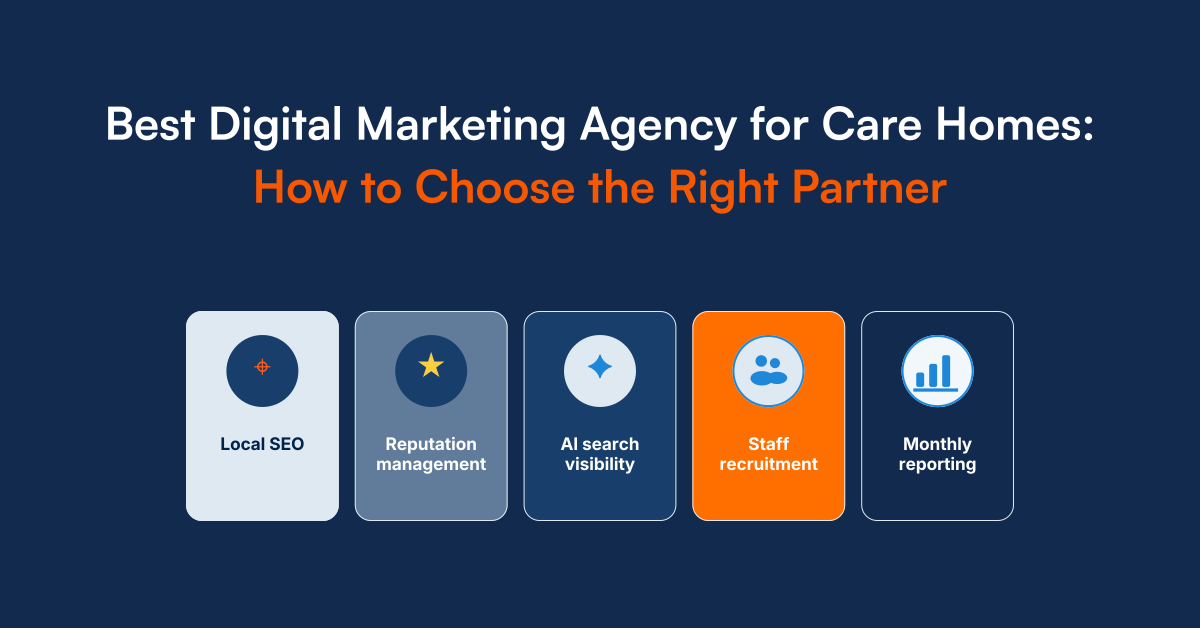
Table of Contents
Introduction
If you’ve typed “best digital marketing agency for care homes” into Google, you’re probably dealing with one of two problems: empty beds that need filling, or rota gaps that need staff. Maybe both. Generalist marketing agencies will happily take your budget and run the same playbook they use for e-commerce brands, law firms, etc. It won’t work, because care is not a normal sales journey — families are making an emotional, urgent decision on behalf of someone they love. Hence, the need for a care sector digital marketing agency.
This guide breaks down exactly what to look for — and what to avoid — when choosing a home care or care home digital marketing agency.
What Does a Care Home Marketing Agency Actually Do?
A care home marketing agency does far more than build a website or run the occasional advert. At its best, it acts as an extension of your team, taking responsibility for how your home or agency is found, judged, and chosen online. In practice, that usually means local SEO and Google Business Profile management, review generation, website conversion, paid advertising, social media, and recruitment campaigns, all joined up around one goal: more qualified enquiries and more completed placements.
What separates specialist care marketing from a generic service is focus. Digital marketing for care providers has to account for CQC ratings, safeguarding sensitivities, and the emotional weight of the decision families are making. The best digital marketing agency for care homes can explain, in plain language, how each activity connects to filling beds or filling rotas, rather than hiding behind jargon and vanity metrics.
Why Generalist Agencies Struggle With Care Home Marketing
Most digital marketing agencies are built around e-commerce funnels: awareness, click, cart, checkout. Care enquiries don’t work that way.
- Decisions are made by adult children, social workers, and hospital discharge teams — not the resident themselves
- Search behaviour spikes around crisis moments: a fall, a diagnosis, a discharge deadline
- Trust signals matter more than price — CQC ratings, reviews, and photos of real staff outweigh a slick landing page
- Recruitment and occupancy are both marketing problems, and most agencies only understand one of them
An agency that doesn’t understand these dynamics will optimise for the wrong metrics — vanity traffic instead of qualified enquiries and completed placements.
What to Look for in Choosing the Best Digital Marketing Agency for Care Homes
1. Avoid generalist agencies
A generalist agency applies the same template strategy to every client, regardless of sector — the same ad copy formula, the same content calendar, the same funnel logic used for a restaurant or an online shop. Care marketing needs messaging built around trust, compliance, and an emotionally difficult decision, not conversion tactics lifted from retail. Generalists also tend to lack the vocabulary of the sector — CQC ratings, safeguarding, discharge pathways, dependency levels — so their content reads as Generalist and families notice.
2. Avoid agencies with more than one sector focus
Even agencies that claim a “healthcare” or “local business” specialism are often spread across dentists, opticians, physiotherapists, and care providers at once. Splitting attention across unrelated sectors means less time refining what actually works for care specifically, and a slower feedback loop — insights from a dental client don’t transfer to a care home’s enquiry funnel. Ask how many of their current clients are care homes or home care agencies. If care is one of five sectors they serve, it isn’t a specialism, it’s a category on a services page.
3. Prioritise specialist agencies
A digital marketing agency working exclusively with adult social care providers has already solved problems you’re about to face: how to phrase ad copy without breaching advertising standards for vulnerable audiences, how to structure a website journey for someone searching in a crisis, and how to generate reviews compliantly under GDPR and PECR. That experience compounds — every care home client makes the agency’s next care home campaign stronger, because the learning stays within the sector instead of being diluted across unrelated industries.
4. Prioritise agencies that focus on Local SEO
Local SEO matters more for care home and home care agencies than almost any other sector, because of how families actually search. Care searches are overwhelmingly local — “care home near me,” “dementia care [town],” “home care agency [postcode].” A few key benefits of prioritising a care marketing agency that focuses on Local SEO:
- You show up at the exact moment of need. Searches like “care home near me” or “dementia care [town]” are high-intent — someone is often searching in the middle of a crisis (a fall, a hospital discharge, a sudden diagnosis). Ranking well locally means you’re visible right when the decision is being made, not weeks earlier.
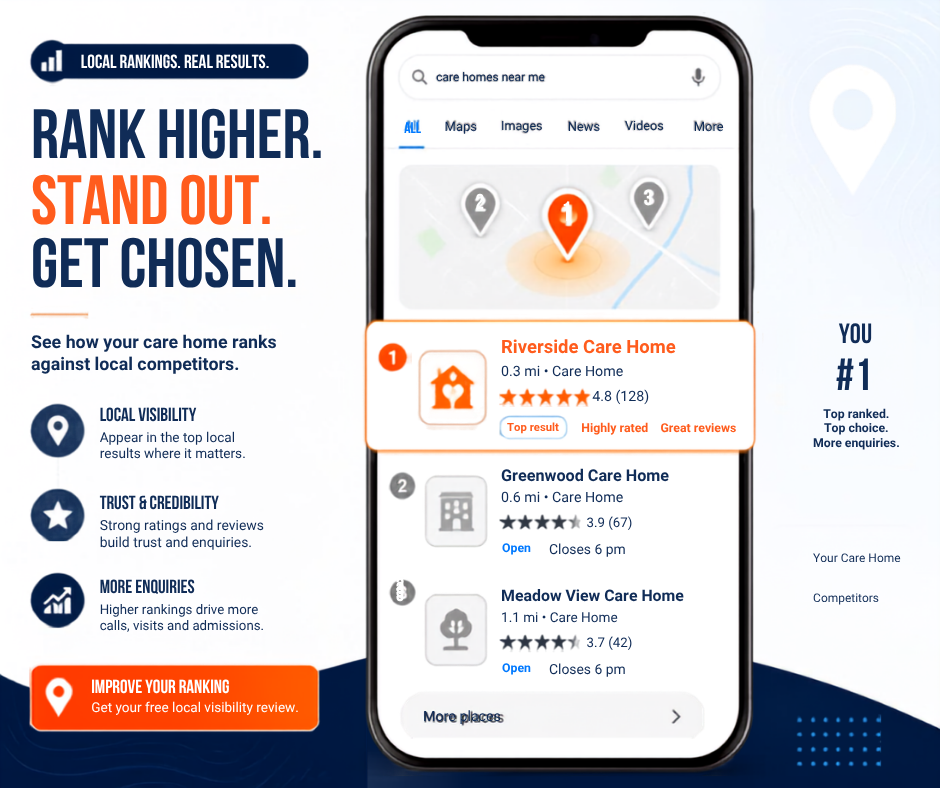
- Map pack visibility drives the majority of click. For local searches, Google’s top-three “Map Pack” results get the lion’s share of clicks — often more than the organic results below them. An agency skilled in local SEO optimises specifically for this, not just general search rankings.
- It’s more cost-effective than paid ads long-term. Once you’re ranking well locally, that visibility keeps generating enquiries without an ongoing per-click cost — unlike Google or Meta Ads, which stop the moment you stop paying.
Without Local SEO, you can be doing everything else right and still be invisible to a family searching from their phone in the next town over.
5. Prioritise agencies that can benchmark you against competitors
It isn’t enough for a care home digital marketing agency to tell you your own rankings — you need to know where you stand relative to the other homes and agencies competing for the same families. A capable care home marketing agency should be able to show you:
- Who your real competitors are in local search, not just who you consider your competitors offline
- Where you currently sit in the Google Map Pack (the top three local results) for your key search terms
- A specific, actionable plan to close the gap — more reviews, better categories, stronger local content, faster page speed, or missing citations
Without competitor benchmarking, you’re optimising in the dark. You might be improving month over month and still losing enquiries to a competitor improving faster.
6. Prioritise agencies that offer reputation management as a service
Reviews are frequently the deciding factor when a family is choosing between two similarly-rated homes. Reputation management should be a structured, ongoing service, not a one-off request — it means a compliant system for requesting reviews at the right moment, monitoring new reviews across Google and directory sites, and having a clear process for responding to negative reviews professionally. An agency offering this as a named service, with a monthly target for new reviews, is treating your reputation as an asset to be actively managed rather than something to hope for.
7. Prioritise agencies offering GEO/AI SEO for AI search visibility
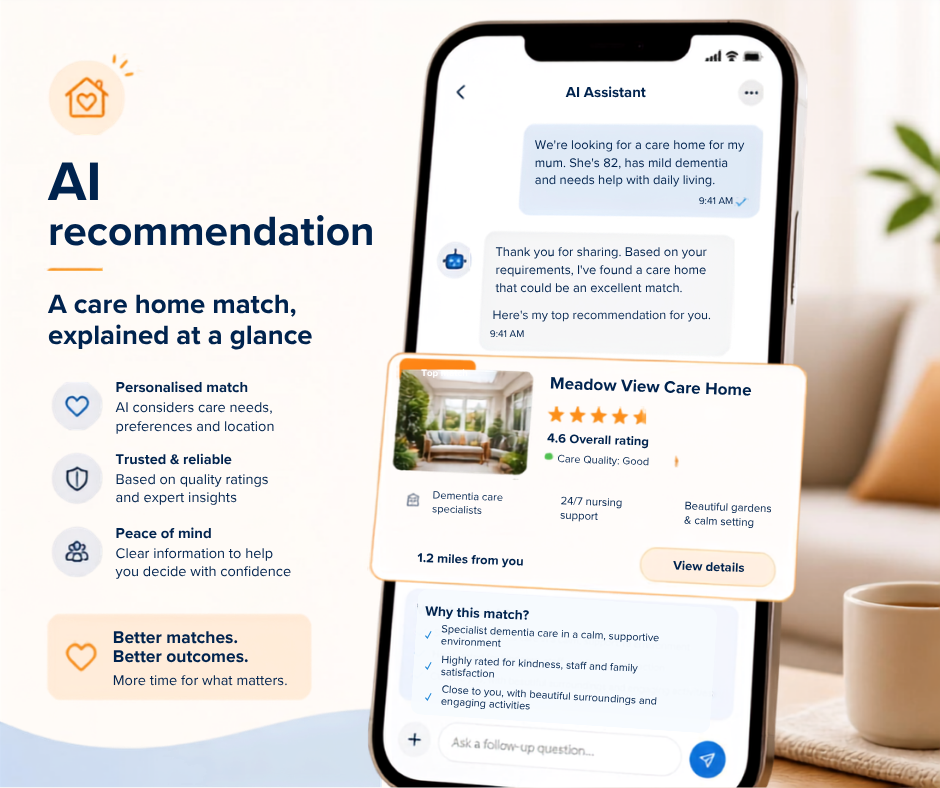
Families and referrers are increasingly asking AI tools like ChatGPT and Gemini questions such as “what’s the best care home near me” or “which home care agencies in [town] have good reviews,” instead of typing a traditional Google search. Generative Engine Optimisation (GEO) is the practice of structuring your website and content so AI tools can accurately read, understand, and recommend you — using schema markup, clear factual content about your services and CQC rating, and structured FAQ content.
GEO doesn’t replace traditional SEO — it complements it. Traditional SEO earns you visibility in Google’s search results and the Map Pack; GEO earns you visibility inside AI-generated answers and summaries, which increasingly appear above or instead of a standard list of links. A care home digital marketing agency investing in both is protecting your visibility across every way a family might now search, rather than only the way they searched five years ago.
8. Prioritise agencies that offer staff recruitment marketing
Occupancy and staffing are two sides of the same problem — without enough staff to cover the rota, even a home with beds available can’t accept new residents. Look for a care home marketing agency that treats staff recruitment as a genuine marketing discipline, with dedicated campaigns targeting carers, nurses, and support workers, rather than leaving recruitment to job boards alone.
The strongest agencies go further and build campaigns around Skills for Care’s values-based recruitment framework — attracting candidates who are drawn to the caring, person-centred nature of the role, not just the pay rate. Values-based messaging and screening tend to bring in staff who stay longer and provide more consistent, compassionate care, which directly reduces the cost and disruption of constant turnover. A care marketing agency that understands this will shape recruitment ad copy, landing pages, and even screening questions around your home’s values and culture, not just a Generalist “we’re hiring” post.
9. Transparent reporting tied to enquiries and occupancy, not just clicks
Traffic and impressions are easy numbers to report, but they don’t tell you whether your marketing is actually working. A campaign can generate thousands of clicks and still produce zero admissions. The best agencies report against the metrics that actually reflect business outcomes:
- Enquiries generated — phone calls, form submissions, and email enquiries, broken down by source (organic, paid, referral) so you know exactly which channel is producing interest
- Tour bookings — how many enquiries convert into an actual visit, which is usually the biggest drop-off point in the funnel and a strong signal of enquiry quality
- Cost per enquiry and cost per placement — what you’re actually spending to generate one enquiry, and ultimately one admission, so you can judge marketing spend against real return rather than guesswork
- Occupancy movement over time — tracking bed occupancy alongside marketing activity, so you can see the actual link between campaigns and beds filled, not just assume one
This kind of reporting matters because it’s the language your registered manager and board actually think in. A CQC-registered manager doesn’t need to know your click-through rate — they need to know whether marketing spend is translating into admissions and covering its own cost. A capable care home marketing agency should be able to show a clear, defensible line from campaign activity through to enquiries, tours, and placements, updated on a regular reporting cadence (monthly at minimum), rather than a dashboard full of vanity metrics that look good but don’t answer the question that actually matters: is this working?
In-House Marketing vs a Care Home Digital Marketing Agency
Many registered managers ask whether marketing should stay in-house or move to a care home digital marketing agency. In-house works well for day-to-day tasks such as posting photos from activities or replying to a review. But local SEO, paid advertising, GEO, and accurate reporting need specialist tools, ongoing testing, and time that most care teams simply don’t have.
A hybrid approach often works best. Your team captures the authentic moments, photos, and stories that only they can provide, while the agency handles strategy, technical optimisation, and measurement. When comparing options, ask what the agency will manage, what they’ll need from your team, and how quickly they can turn around approvals, because slow sign-off can stall even the best campaign.
How Much Does a Care Home Digital Marketing Agency Cost?
Pricing for a care home digital marketing agency varies widely depending on the number of locations, the channels involved, and how much work is included each month. Some agencies charge a flat monthly retainer, others price by service, and advertising spend on Google or Meta is usually paid separately from the management fee.
Rather than chasing the cheapest quote, ask for an itemised proposal that shows exactly what is included, what it will cost, and how success will be measured. A clear, priced scope is one of the simplest signs you are dealing with a credible partner. Vague, bundled packages make it almost impossible to judge value.
How Long Does Digital Marketing for Care Homes Take to Work?
Timelines depend on the channel. Paid campaigns can generate enquiries within days, which makes them useful while longer-term work builds. Local SEO and reputation management typically take around 60–90 days to show a measurable shift in visibility, review volume, and enquiries. GEO and AI search visibility tend to build gradually as your content, schema, and reviews accumulate.
A good care home marketing agency will set these expectations upfront and report progress monthly, so you can see momentum well before the full benefit arrives.
Quick Checklist: Choosing the Best Digital Marketing Agency for Care Homes
Before you shortlist any care home digital marketing agency, check that they can confirm each of the following:
- They work exclusively with adult social care providers
- They can show named care sector case studies
- They offer local SEO and Map Pack benchmarking against your real competitors
- They run reputation management as an ongoing, compliant service
- They include GEO/AI SEO alongside traditional search optimisation
- They offer staff recruitment marketing as well as occupancy marketing
- They report on enquiries, tours, and placements, not just clicks
If an agency can’t tick every box, keep looking. The best digital marketing agency for care homes should meet all of them.
Red Flags to Watch For
- No named care sector case studies or client examples
- Vague, unpriced packages with no clear scope
- No mention of CQC compliance, safeguarding, or GDPR/PECR when discussing marketing to families
- Long contract lock-ins with no results guarantee
- Reporting limited to traffic and impressions rather than enquiries and occupancy
Questions to Ask Before You Sign With Any Agency
- How many care providers do you currently work with?
- Where do I currently rank in the local Map Pack, and who are my real competitors online?
- How do you track phone enquiries and tour bookings, not just website clicks?
- Do you offer staff recruitment marketing alongside occupancy marketing?
- What happens if I don’t see results in the first 60–90 days?
- How do you keep review generation compliant with GDPR and PECR?
- What are you doing to make sure I appear in AI-generated answers, not just Google’s search results?
The Bottom Line
The best digital marketing agency for care homes isn’t necessarily the biggest or the cheapest — it’s the one that specialises exclusively in the care sector, understands local search and AI visibility, benchmarks you against real competitors, and treats reputation and staff recruitment as seriously as occupancy. Ask sector-specific questions, and request real examples when deciding on the best digital marketing agency for care homes.
How Wallwide Media Approaches Care Home Marketing
Wallwide Media works exclusively with adult social care providers — care homes and home care agencies across the UK. We built our service structure specifically around the two things that matter most in this sector: filling beds and filling rotas.
Book a free audit with Wallwide Media If you’d like to see how a specialist approach would work for your care home or home care agency.
Frequently asked questions.
What is the best digital marketing agency for care homes?
The best digital marketing agency for care homes is one that specialises exclusively in the adult social care sector, understands local SEO and Google Map Pack rankings, offers reputation management, and invests in both traditional and AI/GEO search visibility — rather than applying a generic marketing playbook.
How do I choose a marketing agency for my care home?
Look for sector specialism (not a generalist agency serving multiple sectors), a strong local SEO track record, transparent reporting tied to enquiries and occupancy rather than clicks, and a results guarantee.
Why is local SEO important for my care home?
Local SEO is critical because most care searches are hyper-local and high-intent — families searching “care home near me” need to find you in Google’s Map Pack at the exact moment they’re making a decision, often during a crisis or hospital discharge.
Can AI tools like ChatGPT recommend care homes?
Yes — increasingly, families and referrers ask AI tools directly for care home recommendations. This is why GEO (Generative Engine Optimisation) matters: it structures your website and content so AI tools can accurately read and recommend your care home or home care agency.
How much does a care home marketing agency cost?
A care home marketing agency typically charges a monthly retainer that varies by scope, number of locations, and channels included, with advertising spend usually billed separately. The most reliable way to compare quotes is to request an itemised proposal showing exactly which services, reporting, and results targets are covered.
How long does a care home digital marketing agency take to deliver results?
A care home digital marketing agency can generate enquiries from paid campaigns within days, while local SEO and reputation management typically take 60–90 days to produce a measurable shift. Long-term visibility in AI search builds gradually as content, reviews, and structured data accumulate.
Should a care home hire a specialist or a generalist marketing agency?
A care home should hire a specialist care marketing agency because adult social care involves emotional, urgent decisions, CQC-related trust signals, and compliance rules that generalist agencies rarely understand. A specialist applies lessons learned across other care providers, which shortens the learning curve and improves the quality of enquiries.
Wallwide Media Team
Written and reviewed by the Wallwide Media team.