Care Home Marketing- The complete strategy guide.
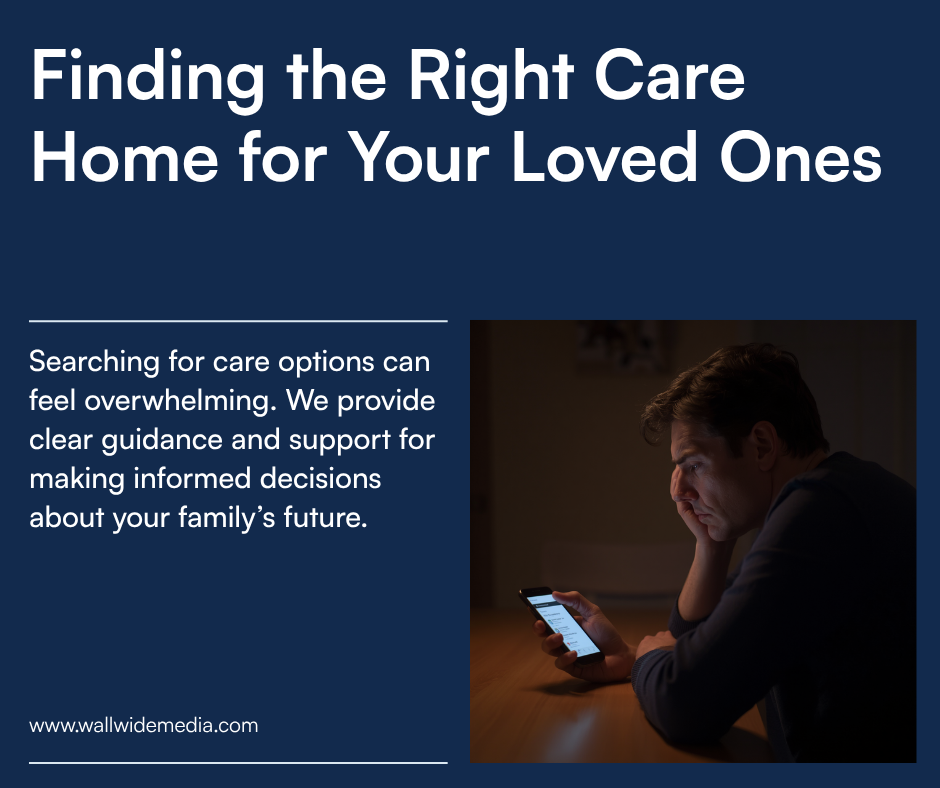
Table of Contents
Introduction
Families rarely walk past a care home and decide to call. They search for one — usually late at night, usually stressed, usually on a phone, usually starting with something like “care homes near me” or “home care for my mum”. If your care home or home care agency doesn’t show up in that moment, it doesn’t matter how good the care is once someone walks through the door. You were never in the running.
That’s what care home marketing actually is: making sure your agency or care home is visible, trusted, and easy to say yes to at the exact moment a family — or a social worker, or a commissioner — is deciding who to call. This guide walks through what a proper care home marketing strategy covers, why it matters more than it did even two years ago, and how to build one whether you’re a single independent home or a multi-site group.
What Care Home Marketing Actually Means Today
“Marketing” for a care home used to mean a leaflet in the local GP surgery and a listing in the phone book. Today, digital marketing for care homes covers a much wider set of channels, and most of them are things families check before they ever pick up the phone:
- Your Google Business Profile — often the very first thing a family sees, before your website
- Your website — does it answer “do you have availability” and “what does it cost” in the first scroll?
- Your Google reviews — families read these before anything else you say about yourself
- Search visibility — do you appear when someone searches “care homes in [your city]”?
- AI search visibility — increasingly, families are asking ChatGPT or Google’s AI Overviews “what’s a good care home in [city]” instead of typing a traditional search
- Social media — a live, human feed reassures families and attracts care workers
- Paid advertising — Google Ads and Meta Ads for immediate visibility while organic growth builds
A care home marketing strategy is the plan that ties these together so they work as one system, rather than a website nobody finds and a Facebook page nobody updates.
Why Care Home Marketing Strategy Matters More Than Ever
Three things have changed the game for adult social care marketing in the last few years:
1. The decision has moved online, completely. Whether it’s an adult child researching options for a parent, or a case manager comparing providers for a care package, the research phase now happens almost entirely on a screen — Google, review sites, social media — before a single phone call is made.
2. AI search is now part of that research. Families are starting to ask ChatGPT, Google AI Overviews, and Perplexity questions like “what’s the best care home in Leeds” directly. Providers who haven’t optimised for this — a discipline often called GEO (Generative Engine Optimisation) — simply don’t get mentioned, no matter how good their care is.
3. Referral pipelines have become less reliable. Word of mouth and social worker referrals still matter, but relying on them alone means unpredictable income — empty beds one month, a waiting list the next, with no way to plan around it. A proper marketing strategy turns that into a consistent, forecastable pipeline of enquiries.
Care providers who treat marketing as a real function — not an afterthought — consistently see the difference in occupancy and enquiry volume. It isn’t complicated, but it does need a plan.
The Core Channels of a Care Home Marketing Strategy
A complete strategy for care home marketing (or home care marketing — the two audiences are close cousins, more on that below) generally covers these channels working together:
Search Engine Optimisation (SEO). Getting your care home to appear naturally on Google — for free — when someone searches “care homes in [your city]” or “home care providers near me”. This is the long-term backbone of a care home marketing strategy: slower to build than paid ads, but it compounds and keeps working once it’s in place.
GEO / AI Search Optimisation. The newer discipline of making sure your provider is the one recommended when families ask AI tools directly. Very few agencies do this properly yet, which makes it a real point of difference for early movers.
Google Ads (PPC). When a family types “care home in Manchester” today, they’re often ready to decide now. Paid search puts you at the top of that result instantly, while your organic SEO builds in the background.
Meta Ads (Facebook & Instagram). Reaches families and potential care staff in your local community before they’ve even started actively searching — useful for both enquiry generation and staff recruitment marketing.
Social Media Management. A consistent, human presence that builds trust with families, reassures social workers and commissioners that you’re an active, engaged provider, and gives prospective care staff a feel for your culture before they apply.
Reputation Management. In adult social care, your Google reviews are arguably your single most powerful marketing asset — and one of your biggest vulnerabilities if left unmanaged. A steady stream of genuine five-star reviews, with every review (positive or negative) answered, does more for conversion than almost anything else on this list.Conversion Rate Optimisation (CRO) & Website Design. Getting visitors to your website is only half the job. If the site is slow, confusing, or doesn’t make it obvious how to enquire, all the traffic in the world won’t turn into calls.
Email Marketing. An underused channel in this sector — staying in touch with families who’ve enquired but not yet decided, referral partners, and even your own team, at very low cost.
Staff Recruitment Marketing. Marketing isn’t only about filling beds or care packages. The same digital toolkit — particularly targeted social ads — works just as well for reaching care workers and drivers in your local area, which matters when rota gaps are as damaging to growth as empty beds.
Building Your Care Home Marketing Strategy, Step by Step
1. Audit where you stand today. Before spending a penny on ads or content, look honestly at your Google Business Profile, your review count and rating, your website’s speed and clarity, and where you currently rank for the searches your ideal families are using. You can’t fix what you haven’t measured.
2. Get clear on your positioning. What genuinely makes your care home or home care agency different — your specialism (dementia care, live-in care, a particular CQC rating), your location, your culture? Every piece of content and every ad should reinforce this, not just describe generic “quality” care.
3. Fix the foundations first. A strong strategy is wasted on a website that doesn’t convert or a Google profile with three-year-old reviews. Website, Google Business Profile, and review management should be sorted before scaling up ad spend.
4. Choose your channel mix. A smaller, independent home or a new provider typically starts with the essentials — social media, Google Business Profile, and basic SEO. A provider ready to scale layers in full SEO, GEO, Google Ads, and Meta Ads on top. There’s no single right mix; it depends on your current occupancy, budget, and how quickly you need results.
5. Track everything back to enquiries and occupancy. The point of a care home marketing strategy isn’t vanity metrics like website visits or follower counts — it’s cost per enquiry, enquiry-to-tour conversion, and ultimately occupancy or filled care packages. If you can’t trace a channel back to one of those, you can’t tell if it’s working.
6. Review and adjust monthly. Search behaviour, competitor activity, and even Google’s own algorithm shift constantly. A strategy set once and left alone for a year will quietly go stale.
Care Home Marketing vs. Home Care Marketing: What’s Different
The channels above apply to both, but the messaging and the moment of decision differ:
Care home marketing is usually about a single, often urgent decision point — a hospital discharge, a decline in a parent’s ability to live independently — and families are frequently comparing two or three specific local homes side by side on availability, reviews, and CQC rating.
Home care marketing is more often about ongoing capacity — families or case managers need a provider who can start a package of visits reliably, and trust and flexibility (can you cover a last-minute schedule change?) weigh more heavily than they do for a one-off home selection.
A genuinely effective strategy speaks to both audiences distinctly rather than using one generic message for everyone — which is exactly why “quality care” alone, without specifics, rarely converts as well as content that speaks to the actual decision each audience is making.
Quick Wins Worth Starting This Month
If a full strategy feels like a lot to take on at once, these are the highest-impact, lowest-effort places to start:
- Claim and fully complete your Google Business Profile — hours, photos, services, and a request-a-review link
- Respond to every existing Google review, positive or negative
- Add a clear, visible enquiry form or phone number above the fold on your homepage
- Post on social media at least three times a week showing real life at your home or agency
- Ask every satisfied family, at the right moment, to leave a Google review
- We cover a fuller set of practical ideas in 20 Care Home Marketing Ideas That Actually Fill Beds, and a template for turning this into a written plan in Care Home Marketing Plan Template & Examples.
We cover a fuller set of practical ideas in 20 Care Home Marketing Ideas That Actually Fill Beds, and a template for turning this into a written plan in Care Home Marketing Plan Template & Examples.
Ready to Build Your Care Home Marketing Strategy?
Every provider’s starting point is different — filling beds, filling care packages, or fixing a recruitment gap. Book a free 30-minute digital audit and we’ll show you exactly where you’re losing enquiries today and what a strategy built for your care home or agency would look like.
See our full range of services or view packages and pricing.
Frequently asked questions.
How do I market a care home with a small budget?
Care home marketing on a small budget should start with free or near-free channels: a fully optimised Google Business Profile, consistent social media posting, and actively requesting reviews from happy families. These channels cost time rather than money and build the foundation that paid channels can later amplify.
What’s the single most important part of a care home marketing strategy?
Google reviews and reputation management are the single most important part of a care home marketing strategy for most providers. Families consistently say reviews are one of the first things they check, and a thin or unmanaged review profile undermines every other marketing channel.
Is digital marketing for care homes different from other industries?
Yes, digital marketing for care homes differs meaningfully from other industries because the decision is emotional, often urgent, and typically involves a family member advocating on behalf of someone else. Messaging that works for e-commerce or B2B falls flat in care home marketing — content and campaigns need to speak directly to trust, safety, and a clear next step.
How long does a care home marketing strategy take to show results?
A care home marketing strategy can show results in as little as a few days for paid channels like Google Ads and Meta Ads, while SEO and reputation-building typically take 60–90 days for a measurable shift. This is why an effective care home marketing strategy combines both immediate and compounding channels rather than relying on just one.
Wallwide Media Team
Written and reviewed by the Wallwide Media team.